
In this guide
BPH, EXPLAINED VISUALLY
Why enlargement
can affect your flow.
As the inner part of the prostate enlarges, it may press on the urethra. The bladder may have to work harder to empty. Symptoms and prostate size do not always match.
A careful assessment helps distinguish obstruction from bladder problems and other causes of urinary symptoms.
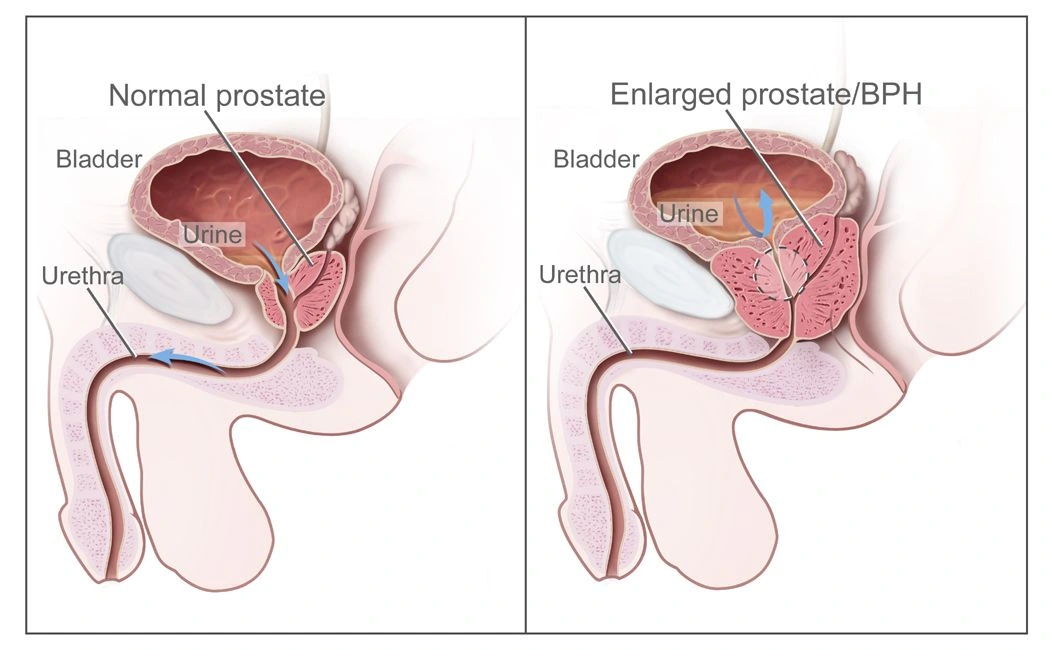

Understanding benign prostate enlargement
Benign prostatic hyperplasia (BPH) is non-cancerous growth of the prostate. It can narrow the urine passage and make bladder emptying more difficult. BPH does not become prostate cancer, although both can occur in the same person.
Passing urine
A weak or interrupted stream, hesitancy, straining and a feeling of incomplete emptying.
Storing urine
Frequent urination, urgency and waking at night. These symptoms can also have causes outside the prostate.
When it becomes complicated
Retention, repeated infections, bladder stones, bleeding or impaired kidney drainage may change the treatment plan.
How BPH is assessed
Prostate size alone does not determine the severity of obstruction. Assessment connects your symptoms with how well the bladder stores and empties urine.
- Your history and symptom scoreUrinary symptoms, medicines, fluid intake, sexual priorities and the International Prostate Symptom Score (IPSS).
- Urine tests and examinationLook for other causes of symptoms. PSA and kidney function testing are considered when relevant.
- Flow and bladder emptyingUroflowmetry and ultrasound measurement of urine left after voiding help assess function.
- Selected further testsProstate imaging, cystoscopy or pressure-flow studies may be needed when the diagnosis or procedure choice is uncertain.
Further reading: EAU: urinary symptom assessment
Patient information: NIDDK: enlarged prostate and treatment options
A closer look at the procedures
These are options to discuss, not a statement that every procedure is suitable or available at every centre.
HoLEP and ThuLEP: laser enucleation
A laser separates obstructing tissue from the surrounding prostate capsule; the tissue is removed through the urine passage. Discuss temporary urinary leakage, bleeding, catheter use and changes in ejaculation.
GreenLight laser vaporisation
Laser energy vaporises obstructing tissue. Unlike enucleation or resection, vaporisation generally does not provide a substantial tissue specimen for laboratory examination.
Rezūm: water-vapour treatment
Steam is delivered into selected areas of prostate tissue. Improvement develops as treated tissue shrinks; temporary swelling, urinary symptoms and catheterisation may occur.
UroLift and iTind
UroLift uses permanent implants to hold tissue away from the urethra. iTind is a temporary device removed after a short treatment period. Anatomy, expected durability and retreatment risk matter.
TURP, Aquablation and simple prostatectomy
TURP removes obstructing tissue endoscopically. Aquablation uses an image-guided waterjet. Simple prostatectomy removes the enlarged inner portion of selected large glands; it differs from radical prostatectomy for cancer.
Prostate artery embolisation
An interventional radiologist reduces blood supply to the prostate through small arterial catheters. The discussion includes vascular anatomy, expected symptom benefit and the possibility of retreatment.
Further reading: EAU: BPH treatment options
Recovery & follow-up
Early recovery
Catheter duration and return to normal activity vary by procedure. Follow your team’s instructions on lifting, exercise, fluids and medicines.
Longer-term review
Review symptom improvement, urinary flow, bladder emptying and sexual effects. Persistent symptoms may also reflect bladder dysfunction.
Seek urgent assessment
Inability to pass urine, fever with chills, heavy bleeding or painful clot retention needs prompt medical attention.
Common questions
Does every enlarged prostate need surgery?
No. The decision depends on symptoms, complications and response to other treatments, rather than size alone.
Can ejaculation be preserved?
Some procedures aim to preserve ejaculation more often than others, but no option guarantees this. Discuss ejaculation and erectile function separately before deciding.
Will BPH surgery remove cancer risk?
No. BPH surgery treats obstruction and usually leaves part of the prostate in place. Future PSA assessment may still be appropriate.
COMPARE THE APPROACHES
Different treatments solve different problems.
This overview supports a consultation. It cannot select a procedure for you. Availability is confirmed individually.
| Approach | What it does | What to discuss |
|---|---|---|
| Medicines | Relax the outlet or gradually reduce enlargement; some medicines target associated symptoms. | Time to benefit, dizziness, sexual effects, ongoing treatment and response. |
| HoLEP / ThuLEP | Separate and remove the obstructing inner tissue using laser enucleation. | Gland anatomy, bleeding, temporary leakage, ejaculation changes and catheter plan. |
| GreenLight | Vaporise obstructing tissue with laser energy. | Expected relief, retreatment, ejaculation and lack of a substantial tissue sample. |
| Rezūm | Use water vapour to treat tissue, which shrinks over time. | Delayed improvement, temporary swelling or catheter use, anatomy and durability. |
| UroLift / iTind | Use permanent implants or a temporary device to improve the outlet. | Prostate size and shape, ejaculation priorities, retreatment and local availability. |
| TURP / Aquablation | Remove obstructing tissue using resection or an image-guided waterjet. | Bleeding, anaesthesia, catheterisation, sexual effects and experience of the team. |
| Simple prostatectomy / PAE | Remove the enlarged inner tissue surgically, or reduce its blood supply through embolisation. | Why this approach fits your gland and health, recovery and alternatives. |
Use this overview to prepare questions, not to select your own treatment. Read the laser & MIST guide ↗
Patient information: EAU: management of male urinary symptoms. Treatment selection must account for individual clinical findings.